 EN
EN

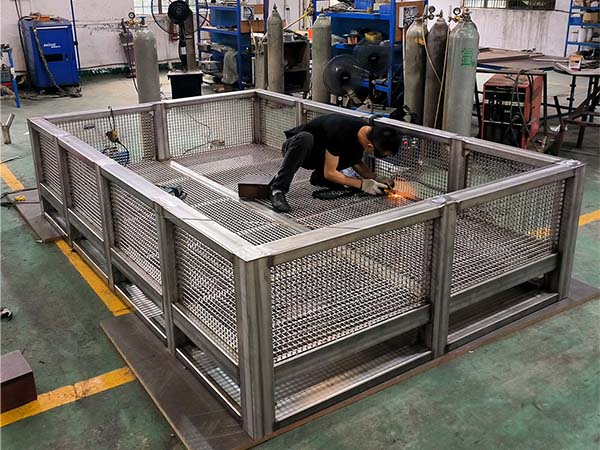
Why Complex Sheet Metal Assemblies Rarely Fit a Simple Welding Plan
Outsourcing custom welding services starts to make sense when a sheet metal assembly stops behaving like a simple weldment. A flat bracket with two fillet welds is one thing. A cabinet frame with thin stainless panels, a tubular subframe, threaded inserts, and a visible powder coated face is another. Heat moves through the part unevenly. Fit-up tolerances stack. A fixture that looks rigid on a workbench can still allow movement once the arc starts. For buyers managing industrial enclosures, architectural metalwork, or public infrastructure components, the real question is not whether welding can be done. It is whether the process can be controlled repeatably without turning the shop into a welding laboratory.
Expensive rework often begins before the first arc. Laser cut blanks may be accurate, but a small bend angle error can push a seam out of alignment. A tube notch that is slightly open can pull the frame during cooling. When those issues meet a manual welding cell optimized for speed, distortion becomes the default outcome. An experienced contract welding partner attacks the problem from the fixture, sequence, and process side, not just the torch side.
The Hidden Cost of Keeping Welding In House
Bringing welding in house can look cheaper on a quote sheet. The true cost shows up in floor space, fume control, consumables, fixtures, inspection, and the people needed to keep procedure records current. For low volume or unpredictable demand, that fixed burden can sit idle for weeks and then become a bottleneck when a project lands.
| Cost area | In house welding | Outsourced welding services |
|---|---|---|
| Equipment and floor space | MIG and TIG machines, fume extraction, fixtures, layout tables | Access to an established welding cell with shared overhead |
| Process documentation | WPS, PQR, and welder continuity records maintained internally | ISO 9001 aligned procedures and records already in use |
| Skill coverage | Limited to current staff and qualifications | Broader mix of sheet metal, tubular, TIG, and MIG experience |
| Volume swings | Idle capacity in slow periods, overtime in busy periods | Scheduling scaled with project demand |
| Distortion control | Often handled by trial and error | Fixture design and weld sequencing treated as engineering tasks |
Standards matter here. AWS D1.1 requires written welding procedure specifications and procedure qualification records for structural work. ISO 9001:2015 clause 8.5.1 expects controlled production conditions. A small in house cell may follow good practices, but keeping those documents, qualifications, and calibration logs alive takes discipline. That discipline is exactly what a specialized supplier sells.
Process Choices That Separate Good Assemblies from Scrap
Complex sheet metal assemblies rarely have one welding answer. Thin gauge stainless may call for TIG root passes to control heat input, followed by balanced MIG fills. Heavier tubular frames may favor MIG for penetration and travel speed. Mixed materials or coated stock can push the decision toward spot, rivet, or adhesive joining before welding even starts.
The deeper issue is heat balance. Every weld creates expansion and contraction. If the surrounding metal is stiff and cold, stress finds the weakest point, often a thin panel or an open tube seam. A capable welding partner thinks about tack placement, back stepping, copper backing, chill blocks, and clamp release timing. Those details separate a door that closes smoothly from a frame that needs force at final assembly.
Tube fabrication adds another layer. A multi radius bend can look perfect on its own, yet a small ovality change at the bend can affect fit up at the weld joint. Automated laser tube cutting helps, yet the welding fixture must hold the real part, not the CAD model.
A Field Lesson from a Chemical Plant Retrofit
During a retrofit at a chemical plant in the southern United States, a fabrication team learned why fit up and weld sequence matter more than raw arc time. The assembly included thin stainless sheet panels, square tube frames, and flanged pipe stubs. The first internal attempt used heavy tack welds and a fast MIG pass. After cooling, panel edges pulled, flange holes missed alignment, and rework consumed two shifts.
An outside welding partner rebuilt the fixtures, switched to TIG root passes on the thin sheet, used balanced MIG fills, and sequenced welds from the center outward. The second assembly passed dimensional checks without force. That result was not magic. It came from treating welding as a controlled process rather than a repair task. The same logic applies to industrial enclosures and architectural metalwork, where visible surfaces and tight tolerances leave little room for hammer and pry bar corrections.
How to Vet an Outsourcing Partner Without Getting Burned
Not every fabrication shop is ready for complex assemblies. A good vetting process goes beyond a machine list. Ask for the welding procedure specifications and procedure qualification records that match the materials and thicknesses in the project. Check welder qualification records against ISO 9606 or the relevant AWS code. Confirm how incoming material is traced, how fixtures are designed, and how dimensional inspection is documented after welding.
Limitations deserve an honest discussion. Outsourcing welding services may not be the best route for a one off emergency repair or a proprietary process that lives inside a single shop. For repeat production, tight tolerance assemblies, and mixed sheet metal and tubular work, a specialized partner can reduce the learning curve. Ask for a first article inspection plan, not just a sample. Ask how distortion will be measured and what happens if a seam pulls. The answers reveal whether the supplier manages welding as a system or simply owns a welding machine.
Where Lambert Fits in a Sheet Metal and Tubular Supply Chain
Lambert has focused on high end sheet metal and tubular fabrication since 2012. The company is ISO certified, carries more than a decade of export experience, and runs a 6,000 m² Industry 4.0 production base. Capabilities include laser cutting with German systems, CNC punching and bending, automated laser tube cutting, multi radius bending, electropolishing, powder coating, and MIG and TIG welding. That mix matters because the welding cell does not stand alone. It connects to cutting, forming, finishing, and inspection under one supply chain. For buyers comparing custom welding services, a partner like Lambert can support industrial enclosures, architectural metalwork, and public infrastructure components with a one stop fabrication approach.
Table of Contents
- Why Complex Sheet Metal Assemblies Rarely Fit a Simple Welding Plan
- The Hidden Cost of Keeping Welding In House
- Process Choices That Separate Good Assemblies from Scrap
- A Field Lesson from a Chemical Plant Retrofit
- How to Vet an Outsourcing Partner Without Getting Burned
- Where Lambert Fits in a Sheet Metal and Tubular Supply Chain